When Studying How Long Do Should You Read and Take Breaks
Ahh!! The terminal couple of months take been CRAZY busy…
And so, I stopped taking breaks because I thought I could go More than done.
The problem?
My productivity completely tanked.
Something needed to change.
And I had a lot of questions… Like, how do breaks assistance or hurt your productivity? How do you lot take an effective break?
Here'southward what I institute…
Taking a break = beingness lazy?
I used to believe that taking a pause = being lazy.
As it turns out, this couldn't exist further from the truth.
And still.
Taking a break at work is kind of taboo.
And let'southward face information technology. No one wants to be chosen lazy.
At present, I'1000 also a bit of a workaholic. But as I watched my productivity tank while I was working harder and harder… I realized something needed to modify.
Then I looked into the science of taking breaks.
As you'll see below, the show is pretty clear:
Taking a interruption at work is good for your productivity.
But there are many unanswered questions:
When should you take a suspension? How often? How long? What should you practise during your break? And more.
I'll reply all your questions about taking breaks hither.
You lot'll notice that the questions and answers are organized into 3 parts.
Part 1 will respond all your questions about the benefits of taking breaks. And so, if you're still doubting that breaks are adept for your productivity, offset at that place.
Part 2 is all about HOW to take constructive breaks. How many? How long? What to do DURING your break. And more.
Function 3 is where you'll detect applied communication about how to make regular breaks function of your daily routine.
Specifically, you'll detect answers to the following questions:
- "Taking breaks is good for my productivity… Really?!"
- "Why is information technology important to take breaks at work?"
- "How does taking a intermission affect my brain?"
- "What are the most of import benefits of taking a break at work?"
- "Does Taking a Break Help Me Make Better Decisions?"
- "How does taking a break impact inventiveness?"
- "How volition breaks affect my ability to focus?"
- "How volition taking a break bear upon my memory?"
- "How practise breaks help me reach my goals?"
- "How often should I take a break?"
- "How long should my intermission be?"
- "What should I do during my intermission?"
- "Should I scan the internet during my breaks?"
- "How much should I move during my break?"
- "Should I workout during my break?"
- "Should I take a nap during my break?"
- "Should I try to meditate on my intermission?"
- "(What) Should I eat and drink during my intermission?"
- "Should I take a coffee break?"
- "So what are the best activities to do during my interruption?"
- "I experience guilty about taking breaks. What should I practice?"
- "What if I don't have time to take a break?"
- "What if I tin't take a break right now?"
- "How can I make breaks a regular function of my routine?"
- "What tools tin I use to help me have breaks?"
Cool?
Let'southward jump in.
Part ane: The Benefits of Taking Breaks
I experienced first manus how NOT taking any breaks at work hurt my productivity.
I was working long days, not-stop.
But when I looked at what I actually got done… The effort and time I put in didn't seem to justify the work I got done.
Why was I so "unproductive"?
As it turns out, I wasn't giving my brain the time to rest that it needs.
"Taking breaks is good for my productivity… Actually?!"
The short answer is…
Yes, really.
In a 2013 article, the New York Times wrote:
A new and growing trunk of multidisciplinary research shows that strategic renewal — including daytime workouts, short afternoon naps, longer sleep hours, more than time away from the role and longer, more than frequent vacations — boosts productivity, job functioning and, of course, wellness.
However…
Science As well says that there are a right and a wrong way to take a pause.
The answers to the questions below will help you get the virtually out of your downtime.
"Why is information technology important to have breaks at work?"
Information technology's important considering of what happens if you DON'T take breaks: Your productivity goes downhill… FAST.
The truth is: Humans are non wired to concentrate for 8+ hours on cease. So, it's no surprise that (on average) in an 8-hour workday, people are productive for only 3 hours or so.
Plus, not taking breaks comes with other negative effects:
- Decision fatigue
- Lack of focus
- Damaged eyes
The adept news is:
As behavioral scientist Nir Eyal explains, the right kind of breaks can counter these negative effects. Expert breaks reduce mental fatigue, boost brain part, and help us stay focused.
Only taking as well many breaks tin backfire, too… Because when you take the wrong kind of breaks it actually gets HARDER to focus.
So, if y'all want to become more washed, you need to brand sure yous accept effective breaks during your workday.
That's only how our brain works…
"How does taking a suspension affect my brain?"
Most of u.s. are knowledge workers – we "call up for a living." And the thinking part of our brain is the prefrontal cortex:
The prefrontal cortex is where our focus, decision making, and logical thinking happens. That'southward pretty much what about of us do all day. So, no wonder our brain needs a break!
Information technology turns out, though, our brain isn't doing "nothing" when we rest…
Inquiry from the Academy of Southern California that suggests that our brain uses the reanimation to make important connections that shape our identity and social beliefs – things like recalling personal memories, imagining the hereafter, and developing a lawmaking of ethics.
That's why giving your brain a chance to residual is crucial.
Specifically, here are the most of import, scientifically-backed benefits:
"What are the most important benefits of taking a break at work?"
When you DON'T take breaks it's bad for your productivity… and health.
On the flipside…
When you DO take breaks, there are lots of advantages.
Here's a quick summary of the almost important benefits:
- Taking regular breaks will assist y'all brand better decisions (by thinking more clearly)
- Breaks spark artistic ideas and new solutions
- Taking breaks helps yous stay focused over long periods of time
- Breaks tin help you retain information in retention (important for studying or rehearsing a speech communication etc.)
- Taking short breaks every now and then assist you re-focus on your big-picture goals.
How do you take advantage of all of this?
By taking the right number, length, and blazon of break.
"Does Taking a Break Aid Me Make Amend Decisions?"
Yes! Hither's why…
Breaks forestall determination fatigue:
As you piece of work, you constantly accept to make decisions. But this actually wears downward our willpower and ability to think clearly.
For example, ane famous study showed:
Judges were less and less likely to grant parole to prisoners later in the day. Decision fatigue explains why this happens… Without taking breaks, the judges were more than likely to go with the easiest determination: just say no.
That'southward tragic in this case. But it applies to ALL decisions. Decisions wear us down over time.
Then, if you want to brand better decisions, make sure you take regular breaks.
"How does taking a break affect creativity?"
Breaks serve as creative fuel.
I'll explain.
Being creative means connecting the dots. Specifically, connecting "dots" that you didn't retrieve about connecting before…
Say, you're stuck trying to figure out a trouble. A quick walk to the around the block can spark an idea for the solution.
Perhaps y'all read a funny slogan on a billboard. Maybe you overhear a conversation while you wait in line. Maybe a chat with a friend turns into the Aha-moment that will go you unstuck.
The point is:
Virtually of the states, when we're working, are focused on "output." Kind of like I'k writing this article right now: I'g focused on putting the words on the screen. Just…
Without input, it's much harder to create quality output.
The good news is that even a short "alter of state" in the form of a intermission tin can be the creative input you need.
That'southward why taking breaks is important if y'all want to be more creative and come up with new solutions.
"How will breaks impact my ability to focus?"
Information technology'due south getting harder and harder to stay focused at work…
…simply taking breaks tin help.
People used to recall concentration is almost "forcing" yourself to stay focused. Only a recent study from the Academy of Illinois BUSTS that myth.
Outset, the scientists confirmed what you already know from experience: if y'all have to focus on a single job for a long time, after a while, your functioning gets worse and worse.
The solution? Psychology professor Alejandro Lleras explains:
"Deactivating and reactivating your goals allows yous to stay focused"
In other words…
Taking breaks helps you stay focused.
Staying focused on ane job for a long fourth dimension is something humans haven't been doing for as well long. So, our minds simply aren't used to information technology.
For this reason, the best thing to practise if you need to concentrate for a long time is NOT to effort and forcefulness yourself to stay focused…
…merely to impose curt, mental breaks on yourself.
"How will taking a break bear on my retentivity?"
In that location's evidence that taking breaks helps us form memories. The brain uses the downtime to review and store new data.
But what if you need to remember a lot of new information over a few days? For instance, studying for a test or preparing for a presentation.
How should you lot construction your "study" sessions?
Well, information technology depends…
New research by David F. Little of Northwestern University suggests that at that place's a "retention threshold:"
If yous take a long break earlier y'all reach that threshold, you won't remember as much. And so, you're better off NOT taking a break.
And then…
DON'T study for 20 minutes, take a 30-infinitesimal break then written report for some other 20 minutes. Yous'd be amend off powering through the 40 minutes without a break.
However…
Taking lots of mini-breaks might be even improve. In the study, the group that took 5 mini-breaks in 40 minutes performed best.
"How do breaks aid me reach my goals?"
Y'all might worry that when yous accept a pause you lot'll lose momentum.
There'south some truth to that.
When I'grand in the zone, I similar to proceed going…
The problem?
When you piece of work for besides long without taking a interruption, you might lose rail of what y'all're really trying to do. Researchers called this effect "goal habituation."
The solution scientific discipline suggests is "goal reactivation"… by taking short breaks every at present then.
Office 2: How to take Effective Breaks
Every bit we've seen, the bear witness of the benefits of taking breaks at work is pretty articulate.
But let's dig a petty deeper into HOW to take constructive breaks…
For example:
- How often should yous take a break?
- How long should your breaks exist?
- What should y'all practice during your breaks?
You'll find the answer to those questions below.
"How often should I take a pause?"
Our focus, energy, and motivation moves in "waves."
(Biologists call information technology Chronobiology.)
That'southward probably why I always hit a slump around 3 pm…
How can taking breaks help?
Well, your interruption schedule should match that rhythm.
Tony Schwartz, the author of The Power of Full Appointment, calls this "pulse and pause." And, he found that humans tend to movement from full focus to fatigue every 90 minutes.
At present…
Many studies have looked at the optimal interruption-schedule.
The results differ slightly. But as yous'll encounter, the sweet spot seems to exist somewhere betwixt 30 minutes and 90 minutes:
- The University of Illinois written report cited before suggest taking a suspension once every hour.
- Inc. Magazine suggests a break every 60-90 minutes.
- Time-tracking app Desktime says it'southward best to accept a intermission every 52 minutes (followed by a 17-minute interruption).
- Based on the written report of professional musicians, Robert Pozen of the MIT Sloan School of Direction suggests taking a pause every 75 to ninety minutes.
- The pop Pomodoro Technique promotes taking a break every 25 minutes (followed past a 3-5 infinitesimal break and so a xv-xxx infinitesimal break every 90 minutes or so)
But information technology's not about the exact number of minutes…
How often yous should take a break too depends on the TYPE of work you demand to do.
For instance:
If you can stay fully focused for ninety minutes as you write, go along the momentum for as long as you lot tin.
If your thoughts start to wander after twenty minutes of reading, information technology's ameliorate to take a short break. Give your focus-muscle a take chances to relax. Only a few minutes later, yous'll come back fresh.
(Remember: the brain needs time to consolidate new information.)
"How long should my break be?"
Remember, our bodies naturally go through an ebb and flow of high and low energy. Ideally, you desire to take advantage of that.
And so, what is the ideal length of your work breaks?
After reviewing all the studies and inquiry that's out there, here'due south my best advice:
Have SHORT breaks – say v to fifteen minutes – every hour or so. Accept a longer break – at least 30 minutes – every 2 to 4 hours (depending on your job).
I know that's pretty broad…
Just unless y'all want to follow a super strict schedule, based on all the research, that's the best advice I can give.
For a more than exact schedule you could follow 1 of these methods:
- Take a 17-minute intermission every 52 minutes (see the Desktime written report)
- Take a 5-minute break every 25 minutes (following the Pomodoro Technique)
- Every bit a general dominion: Accept a 15-minute break for every hour of focused work.
Merely remember to take a longer pause every 2-4 hours, besides.
Another thing to call up is that top performers don't necessarily spend more total time "working."
Only they Practice spend more time completely focused.
For example…
Researcher K. Anders Ericsson found that top performers (including musicians, athletes, etc.) rarely piece of work for more than than four and a half hours per mean solar day! Yet they engage in then-chosen "deliberate practice."
James Clear gives a good definition:
Deliberate do refers to a special type of practice that is purposeful and systematic. While regular practice might include mindless repetitions, deliberate practice requires focused attention and is conducted with the specific goal of improving performance.
It's easy to see why breaks are crucial for this. Remember, taking a pause helps your mind to stay focused and re-focus on your goals.
Here'south my personal focus routine to get into the zone.
"What should I do DURING my break?"
And so, the ability to focus is what makes you more than productive while you piece of work. And taking breaks is crucial only…
What should you lot do during your break?
In short: Anything that gives your brain a take a chance to relax.
Hengchen Dai from the Wharton School of the Academy of Pennsylvania says:
"Based on past research, we would look that the more relaxed and disengaged from work people experience during a intermission, the more likely they will be to benefit from taking time off."
So, you shouldn't to whatsoever work on your break.
Duh.
But this is important…
Information technology's tempting do like shooting fish in a barrel tasks that don't require your total attention during your break… don't.
Scientific discipline clearly says:
If you want to exist more than productive overall, don't piece of work during your interruption!
The whole goal of taking a break is to shift your attention. In fact, the goal is to cease concentrating at all.
And then let's await at some specific things you tin can do during your interruption. Should yous go for a walk? Should you lot drink coffee? Should y'all accept a nap?
I'll answer those questions next.
"Should I browse the net during my breaks?"
Yes and no.
I'll explicate.
On the one hand, yous desire to completely take your heed off of piece of work. And scrolling through Instagram or watching your favorite YouTube vlogger can certainly practise the pull a fast one on.
But at that place's a downside to goofing off online during your break, besides…
The problem is that not-stop social media utilise increases stress. And it gets worse. The Harvard Business Review reports that social media tin can besides hurt your ability to focus and learn.
Basically, your brain gets hooked on instant gratification of seeing the next Instagram picture. And then another one. And another one.
This makes it harder and harder to focus on things that's non immediately every bit rewarding. You lot know, things like doing your job.
There'south also a Southward Korean study that shows that tech-free breaks "increase vigor and reduce emotional burnout."
And then ideally, you want to stay away from your screen.
Now…
I can't say I don't browse the internet on my breaks.
But would I recommend information technology?
No.
"How much should I move during my suspension?"
When I had a wellness scare a couple of years ago, my doc told me to do ane thing:
Walk.
E'er since so, I walk everywhere.
I do walking meetings. I make all my telephone calls when I walk around NYC. We even did a Walking Challenge here at Social Triggers to get people to walk more than.
So, needless to say, I believe walking is a GREAT thing to exercise during your break.
Walking is essential for your physical and emotional health. Information technology reduces stress and boosts inventiveness.
The adept news is:
You don't have to exhaust yourself.
A short 5 minute walk is enough.
If you lot can, walk exterior. Spending time in nature is ideal.
Simply really, the big benefit comes from getting upwards…
Sitting all solar day is TERRIBLE for your health.
That's why just a little bit of movement during your break is and then good for you. And that'south even beyond all the positive effects of taking a break in the first identify.
Then, you don't have to move a lot. Simply information technology's important that yous practise.
"Should I workout during my break?"
Every bit I mentioned, to get the do good of an effective break, y'all don't need to move a lot.
Does that mean you shouldn't workout during your break?
No.
You absolutely can.
Studies have shown that a moderate level of cardio activeness tin can boost creativity and productivity for upt to two hours.
"Almost every dimension of cognition improves from thirty minutes of aerobic exercise."
There's a slight catch, though… If you don't work out regularly, you lot might be exhausted rather than refreshed form the workout.
Just think:
The good news is you don't need to work out that hard. A short walk is enough to get the benefit of taking a break AND reduce the negative effects of sitting all day.
Do as well reduces stress and anxiety. Merely I don't have to explain why staying fit is proficient for your productivity…
"Should I have a nap during my break?"
Sciences says…
Aye.
The power of a adept nap is undeniable:
- Enquiry on pilots shows that a 26-infinitesimal in-flight nap (yes, there was a copilot lol) enhanced performance by 34% and overall alertness by 54%.
- A study published in Nature Neuroscience tested how naps touch our perception throughout the twenty-four hour period. People who took a 30-minute stayed more than alert (a lx-minute nap was even better).
- A 2012 study found that a daily, ten- or 20-minute nap can significantly increase productivity and bookish focus.
Now, the important follow-up question is…
How long should you nap for?
Based on the expert guide on naps by Jennifer Ackerman (who also wrote Sexual practice Sleep Eat Drink Dream: A Day in the Life of Your Body), you accept 3 options:
- Take a curt, 20-minute nap: A quick "true cat nap" should make y'all more alert, help you concentrate, and give your mood a picayune boost. If you want to give yourself an extra boost, beverage a cup of java correct before… The caffeine volition boot in right as you get back to work.
- Take a 45-minute nap (just non more!): Naps of up to 45 minutes will also include REM sleep. This means you lot should see even more benefits from your nap (like a boost in creative thinking).
- Take a loooong (ninety- to 120-minutes) nap: This will requite you enough fourth dimension to go through a full sleep cycle. Then, you won't have to bargain with sleep inertia.
But be careful. When yous nap…
Beware of sleep inertia.
If y'all sleep more than 45 minutes only not long enough to become through a full sleep-cycle, it might accept y'all a long time to be fully awake again.
"Should I try to meditate on my intermission?"
Okay, I've tried meditating… but I can't do it.
That'south not to say, there are no benefits. And it'southward definitely a bully idea to do it during your breaks.
Recall, the goal is to completely disconnect your encephalon from work. When yous meditate, ideally, that's what you'll feel.
The best practice for meditating during a break is to do it during ane of your longer breaks. Say, your lunch-break.
"(What) Should I eat and drink during my suspension?"
Our brains basically run on glucose:
The brain lacks fuel stores and hence requires a continuous supply of glucose.
That's why information technology'south a great thought to fuel your encephalon during your breaks.
Here a are some ideas for salubrious snacks:
- Almonds
- Fresh fruit or dried fruit
- Protein bar
- Wasabi peas
- Hummus and veggies
- Kale chips
- Love apple juice
- Yogurt
- Apples and peanut butter
Then, become ahead and use your break as an opportunity to have a snack. Or vice versa…
Use your urge to snack as an opportunity to accept a break!
"Should I take a coffee suspension?"
Should you actually drink coffee during your coffee intermission?
Every bit information technology turns out, yep, at that place'south evidence that drinking java is adept for your productivity… Caffeine keeps you alarm, it can reduce stress, and keep you active.
Now, let's say you take 2 coffee breaks. And let'southward say y'all wake up between 6 am and eight am…
When should you take your coffee breaks?
Apparently, the perfect fourth dimension for your kickoff java suspension is between nine:30 am and 11:30 am. So, your second java intermission should be betwixt one:30 pm and 5:xxx pm.
Oh and remember: You tin beverage coffee correct before you lot have a 20-infinitesimal nap, too. That way, when yous wake up, yous'll get the jolt of caffeine at the perfect fourth dimension.
Now…
Information technology looks like drinking java is pretty good for your productivity. But whether yous like to drink coffee, water, or tea, there's another benefit of the typical "coffee break:"
Information technology's oftentimes a skillful opportunity meet and talk to people.
So, let'south summarize…
"So what are the best activities to practise during my pause?"
Retrieve:
The goal of your breaks should exist to fully disassemble from work – even if it's simply for a moment.
And so, I'll say it again… Don't try to combine your suspension with some other stressful activity. Don't do "calorie-free work" like checking emails. If you're chatting with someone, don't talk about work issues.
In his book When: The Scientific Secrets of Perfect Timing, Dan Pinkish cites a South Korean report to prove this betoken:
"Psychological detachment from work, in add-on to physical disengagement, is crucial, equally continuing to think about task demands during breaks may result in strain."
With that in mind, what are some good activities to do during your intermission?
How about you…
- Get for a curt walk – sitting all day is bad for you. Moving is better than existence stationary.
- Go exterior – spending fourth dimension in nature will boost your creativity and ability to focus.
- Stretch – whatsoever you demand to do to get a moment to relax
- Take a nap – the power of a good nap is undeniable.
- Fantasize – the less you're concentrating, the better (it will ease stress and boost your mood).
- Declutter your desk or putter – this should go your mind off piece of work for a moment (and help you come back re-focused).
- Talk to people – friends and co-workers
- Give your eyes a pause – Look away from your screen for at least 20 seconds every 20 minutes (the 20-20-20 rule)
- Have a snack/take a coffee break – your encephalon needs fuel to work properly.
Whatsoever yous practice, the qualities of a good break remain the same. To summarize…
Do something that will…
- Shift your focus abroad from piece of work
- Get your eyes off the screen
- Get you out of your chair (and moving just a trivial bit)
- Requite your brain a chance to truly relax
- Allow y'all to interact with other people
Cool?
Cool.
Now that y'all know how to have effective breaks, how practise you actually make this part of your daily routine?
If you accept questions virtually that, I'll answer them in part 3 now.
Part three: How to Implement Skillful Breaks in Your Workday
If y'all doubted that breaks are important, I hope you meet now that they are.
And if you've wondered how to take effective breaks and what to do DURING your breaks… now you know.
Simply how practice you make this part of your workday. Every twenty-four hours?
The first problem is that most people feel GUILTY about taking any kind of break:
Co-ordinate to one study, simply 25% of people have more than a lunch break. Nigh people just "power through" their eight+ hours of work.
This is based on a deep rooted belief…
Many cultures but come across taking breaks as being lazy.
Simply as we've seen, that's non true.
And so why practise we still experience guilty most taking breaks?
"I feel guilty about taking breaks. What should I do?"
The first thing you lot should do is…
Terminate feeling guilty about taking breaks.
Easier said than done, I know.
Simply at least now, you have all the show that proves: Taking breaks really makes you MORE productive.
Depending on the work you practice, it can be critical that you take enough breaks. Which reminds me of a recent uber driver…
He told me, "man, I've been driving for 12 hours. I'm gonna call information technology quits for the twenty-four hours soon." Lol. Yes, you probably should.
Or take the written report that found that doctors stop washing their hands equally the twenty-four hour period goes on if they don't take enough breaks.
Or allow me remind you of pinnacle athletes that only do for 3-4 hours a day. The difference is… They're highly focused WHEN they work.
I'chiliad not saying yous need to take a 90-infinitesimal nap every solar day.
But if you lot do, that'due south okay, too.
As long as it helps you come up dorsum to piece of work with fresh focus, better mood, and more motivation, there's admittedly no need to experience guilty near taking a break.
But don't have it from me…
Tony Schwartz is the head of the productivity consulting firm The Energy Project (they propose companies similar Google, Facebook, and Apple). Schwartz put information technology best in a contempo Fortune interview:
"When demand in our lives intensifies, nosotros tend to hunker down and push harder (…) The problem is that, without whatsoever reanimation to refresh and recharge, we're less efficient, make more mistakes, and become less engaged with what we're doing."
The next problem with taking breaks?
People think they only can't afford to have a break…
"What if I don't have time to have a suspension?"
"I don't have time" is maybe the biggest prevarication nosotros tell ourselves.
At present, I get that there are times where things get crazy. You experience like there's just NO WAY you tin have fifty-fifty 15 minutes to relax.
But recall 2 things:
First…
Something is better than goose egg.
Fifty-fifty a micro-break can help you refocus.
Second…
Non taking whatever breaks will brand y'all LESS productive.
That's the weird thing.
To quote Dan Pink, who wrote When: The Scientific Secrets of Perfect Timing:
I used to power through breaks, for whatever reason. My view was that amateurs took breaks and professionals didn't. That's just diametrically, 100 percent erroneous. Professionals have breaks, amateurs don't accept breaks. I started thinking about breaks equally part of my performance, not equally a deviation from my operation, and yous should, as well.
Yep! Remind yourself of this next fourth dimension you experience like you have besides much to do to accept a interruption…
Professionals have breaks.
"What if I can't take a intermission right at present?"
Okay…
Let's say you Actually can't take a pause right now.
But you're losing focus. What can you do?
If possible, I suggest yous switch tasks.
This will allow you to change your focus. It tin near feel like you're taking a break. Because you are… sort of. Y'all're using a different part of your encephalon.
Speaking of switching tasks:
I recently read an interesting story almost Elon Musk. Plain, he breaks up his entire day into 5-minute slots.
If you're actually THAT busy, dividing your day into smaller chunks tin can give your productivity a boost.
Yous don't have to go as far as Musk. Only how virtually xv- or thirty-minute slots?
Yous'll be surprised what you can achieve when you truly focus for half an hour. Then, you'll feel similar you have fourth dimension for a break, besides.
"How tin can I make breaks a regular part of my routine?"
So you want to make taking breaks a part of your routine.
That's the GOAL.
But it can exist difficult. Especially if you're busy and driven like most entrepreneurs are. That'southward why you demand a arrangement that automatically makes breaks a regular function of your day.
Here are 3 good approaches:
- Schedule breaks on your calendar: If you're working on a strict schedule, blocking fourth dimension out for breaks on your calendar is your best bet – fifty-fifty if it's simply two 15-minute breaks.
- Ready a timer: If you lot practise a lot of high-focus work, working in "sprints" seems the most productive approach. You lot tin can use some version of the Pomodoro Method and set a timer for thirty-minutes, go with the 52-minute piece of work and 17-minute break intervals, or whichever fourth dimension is optimal for you.
- Brand a "break appointment:" If you're having a hard time sticking to your break schedule, make an engagement with someone to accept your breaks together. Information technology's a bit tricky to get on the same schedule. Only this style you'll accept someone to remind y'all to accept a break.
There are some great tools that tin can help y'all, besides…
"What tools tin can I employ to help me have breaks?"
There are lots of piece of cake-to-employ time-tracking apps.
Here are some pop apps:
- Focus Booster app
- DeskTime
- FlowTime
- Be Focused – Focus Timer
Honestly? They all practise the aforementioned affair. Most of these are too fancy for me. I like to go on it elementary and distraction-free.
That's why my favorite tool is… Google.
Check it out:
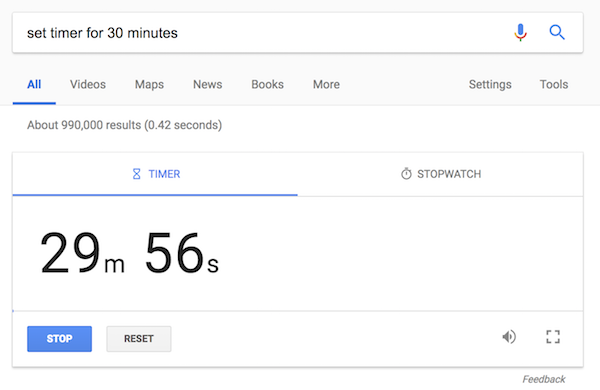
Just type "prepare timer for [Ten] minutes" into your search bar.
You'll have a timer running correct there in your browser!
Or just put a reminder in your calendar:
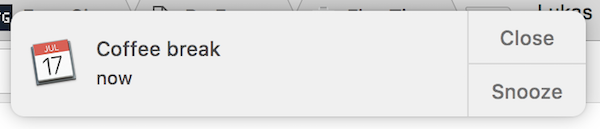
Set it to echo every 24-hour interval.
Give the apps higher up a try and see what works for you. If you lot want to keep it simple, use the timer on your phone and your calendar.
Any other questions nigh taking breaks?
I tried to answer all the common questions nearly taking breaks at piece of work hither.
If I missed something, let me know in the comments.
Also, tell me most your feel.
How does taking breaks bear on your productivity?
Source: https://socialtriggers.com/why-you-need-to-take-more-breaks-and-how-to-do-it/
0 Response to "When Studying How Long Do Should You Read and Take Breaks"
Post a Comment